
Tata Motors and Mahindra & Mahindra have cut the prices of their SUV models to boost demand. Tata Motors has revised the starting prices of its flagship SUVs, the Harrier (Rs 14.99 lakh) and the Safari (Rs 15.49 lakh) and extended benefits of up to Rs 1.4 lakh on other popular SUV variants.

Guenter Butschek will start his new job by Feb. 15
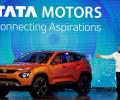
Tata Motors on Monday said the voluntary delisting of its American Depositary Shares, representing ordinary shares, from the New York Stock Exchange will become effective close of trading on January 23, 2023. After Monday, there will be no over-the-counter market trading of the American Depositary Shares (ADSs) in the US due to regulatory restrictions under the Indian law, Tata Motors said in a regulatory filing.

Tiago comes with a good fuel efficiency of 23.84 km/ltr on Revotron 1.2L petrol and 27.28 km/ltr on Revotorq 1.05L diesel.
The new SUV from the Tatas will compete with the likes of Jeep Compass, Hyundai Creta, Hyundai Tucson and the Mahindra XUV500.

The hatchback has been priced strategically at a notch above the Nano and way below the Tata Bolt.
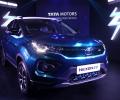
Powered by Ziptron technology, the electric SUV for the personal segment comes with a range of 312 km on a single charge and a high voltage system, fast charging capability, extended battery life and class leading safety features. Besides, it has 35 connected car features as well. The Nexon EV will be available in three trim levels across 60 authorised dealerships in 22 cities, the company said at the launch.

Unveiled in December last year, the Altroz, which is the industry's first BSVI diesel-ready car. is also the first vehicle model based on the brand's Alfa platform and the second vehicle showing the Impact 2.0 design language. Besides Altroz, Tata Motors also launched the BSVI versions of Nexon, Tiago and Tigor.

The company is banking on investments lined up for product development and other innovations.

JLR, the maker of Jaguar F-Type and Range Rover Evoque, was a jewel in the crown of Tata Motors till two years back. But, it has been struggling because of the pending Brexit, a sharp contraction in sales in China, a shift in consumer preference from diesel to gasoline in Europe, higher taxes on diesel vehicles, and tightening regulations.
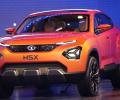
With the theme 'Smart Mobility, Smart Cities', the company's display at the Auto Expo is focusing on intelligently-connected cities designed to offer convenience, safety, security, and efficiency to its customers.

Pawan Munjal, chairman and managing director of Hero MotoCorp, the country's biggest two-wheeler maker, leads the pack among automobile CEOs.

Walmart CEO Douglas McMillon came first in the CEOWORLD magazine's global ranking of the best chief executives across all industries for 2019.

Tatas' best bet would be to find an insider who understands the systems, say headhunters

Gains were led by index heavyweights Reliance Industries and Infosys.
This will ensure its vehicles reach dealers much faster and delivered to buyers in a maximum of three days, reports Shally Seth Mohile.

'One can charge it at home, in the office, on the go. All it needs is a 15 Amp electric socket which is found is all our homes.'
Tata Motors ended the year selling 21,012 Nanos, up from 16,901 in FY15.

Nano remains a cautionary tale of misplaced ambitions and a drag on profit.

The commercial vehicle business is one of the mainstays for the Tata group, highlighting the importance of Girish Wagh's appointment.

At Rs 470,000 for the base petrol variant, Tigor is now the cheapest compact sedan in the country

The GST Council last year imposed a cess of 15 per cent on hybrid vehicles, in addition to the 28 per cent GST, leading to a total tax burden of 43 per cent against a previous tax rate of 28 per cent.
The new obsession on cost control is powered by the company's 'GEAR' (Generate idea, evaluate, action and realise the idea) programme.

The Tata Group has close to 110 companies and Chandrasekaran plans to bring this number down to around five or six.

According to research by IHS Markit, for an ecosystem still grappling with infrastructure issues -- the high cost of EVs and a greater OEM (original equipment manufacturer) focus on electrifying two-wheelers and commercial vehicles first -- the share of such vehicles is expected to be 4 per cent by 2030, reports Pavan Lall.

The challenges of transition to stricter emission norm BS-VI from BS-IV and compliance to new safety norms thereby making vehicles costlier are lurking around the sector.

While hybrids, CNG and biofuels found favour in 2018 among many carmakers including Maruti Suzuki, Mercedes-Benz, Toyota and Honda, others such as M&M and Tata Motors have shown full faith in electric vehicles.
Under its Turnaround 2.0 programme, Tata Motors will work to improve its sales capabilities -- "as the product itself is not enough" -- use experiential marketing to excite the market and cut costs to make its offerings more competitive.

Among the cars unveiled at the Auto Expo on Wednesday was Mahindra and Mahindra's e-KUV for Rs 8.2 lakhs ex-showroom Delhi. With a single charge range of 150 km and a 55 min fast charging upto 80 pc, it was both a head-turner and a conversation-starter.
 © 2026 Rediff.com - Advertise with us - Disclaimer - Privacy Policy - Sitemap - Feedback - About us - Terms of use - Grievances